A Hammock Camping Gear Guide: Choosing Bridge Hammocks, Tarps and Bug Nets
Hammock camping took hold around this trail for a practical reason rather than a fashionable one. The pocosin holds water, flat dry ground is scarce, and the trees are everywhere — so hanging solves the problem the terrain sets.
This hammock camping gear guide covers the choices that actually change a night's sleep: hammock shape, bug net coverage, tarp size and bottom insulation.
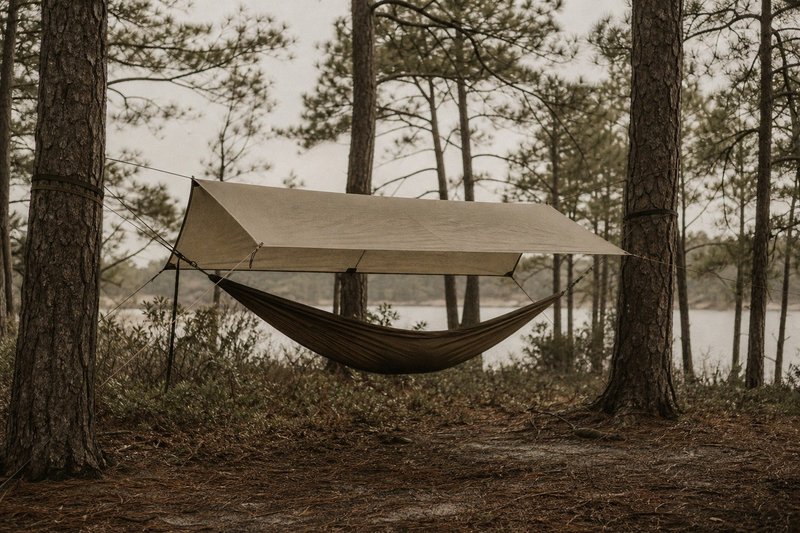
01 — ShapeGathered-end or bridge: the choice that shapes everything else
Almost every hammock falls into one of two families. A gathered-end hammock is a flat panel drawn to a point at each end — simple, light, and the default for good reason. A bridge hammock uses spreader bars at the head and foot to hold the fabric open, producing a flatter lie at the cost of weight and complexity.
Which suits you is mostly anatomy, not opinion. Sleepers who find that a gathered-end hammock presses uncomfortably against the calves often get on far better with a bridge. Sleepers who like being cocooned generally prefer the gathered end and never look further. That is the whole of the debate, stripped of the forum argument that usually surrounds it.
02 — Bridge hammocksA short guide to what a bridge hammock does differently
The spreader bars are the entire idea: they keep the fabric open across its width so the sleeping surface stays closer to flat. The result is a lie that side-sleepers and anyone with sensitive knees often much prefer.
The costs are real. A bridge hammock weighs more, packs bulkier, and is less forgiving about hang angle and anchor spacing — a tight stand of pocosin shrub is a harder place to rig one than a pine upland. The question of the best bridge hammock has no general answer; it depends on shoulder width, sleeping position and how much weight you will carry to get a flatter night. Treat any list of the best bridge hammock options as a starting point for your own testing rather than a verdict.
Field noteRig any new hammock in a garden before carrying it twenty miles. The first night with unfamiliar suspension is not the night to be learning.
03 — InsectsBug net coverage, and why it is not optional here
From May into September the Carolina coastal plain produces mosquitoes, deerflies and ticks in numbers that make an unprotected hang untenable. A bug net is core hammock camping gear on this coast, not an accessory — integrated into the hammock, or a separate sock that drops over the whole thing.
Separate nets are more versatile and easier to replace; integrated ones are lighter and one less item to lose. Either way, check the zip and the seams before the season rather than at dusk on the first night. The seasonal grid shows how sharply the insect load falls away in late autumn, which is the other way to solve the problem.
04 — InsulationTarps and bottom insulation for a coastal hang
Two things ruin a night more reliably than a mediocre hammock. The first is an undersized tarp: coastal rain arrives sideways, and a tarp that only just covers the hammock in still air will not in wind. The second is compressed bottom insulation — air moves freely under a hammock, so a sleeping bag flattens exactly where your weight sits and stops insulating.
Below roughly 60°F that means an underquilt, or a closed-cell pad as the cruder alternative. Down holds more warmth per gram; synthetic copes better with the damp, which on this coast is a genuine argument rather than a theoretical one. The wider gear notes cover filters, stoves and camp seating, and the hammock camping page covers hanging in the Croatan specifically.
05 — QuestionsCommon questions about hammock camping gear
Is hammock camping better than a tent in the Croatan?
On this ground, usually yes. The pocosin holds standing water for weeks after rain and flat dry pitches are genuinely scarce, so hanging sidesteps the problem the terrain creates. Pine and hardwood give plenty of anchor points.
What is the best bridge hammock for a beginner?
There is no single answer, and anyone claiming one is selling something. A bridge hammock suits sleepers who dislike the calf pressure of a gathered-end hammock; the trade is more weight, more setup fuss and a narrower comfortable hang angle. Try one before committing.
Do I need a separate bug net?
Between May and September on the Carolina coast, yes — an integrated or add-on bug net is not optional. Deerflies and mosquitoes here are a serious proposition rather than a nuisance.
How cold can you hammock camp without an underquilt?
Less cold than most people expect. Air moves under a hammock, so a sleeping bag alone compresses and loses its loft where your weight sits. Below roughly 60°F most hangers want dedicated bottom insulation.
What hammock camping gear matters most on a first trip?
Suspension and tarp coverage, ahead of the hammock itself. A comfortable hammock under an undersized tarp in coastal rain is a bad night; an average hammock properly rigged and covered is a good one.
Are there trees along the whole Neusiok Trail?
Yes. The route runs through pocosin shrub, pine upland and hardwood bottom, all of which offer anchors. The boardwalk sections are the exception, and camping on them is neither permitted nor pleasant.