Hammock Camping in North Carolina: Hanging in the Croatan Forest
A hammock-camping community grew up around this trail for a practical reason rather than a fashionable one: on this ground, hanging solves a problem that pitching a tent does not.
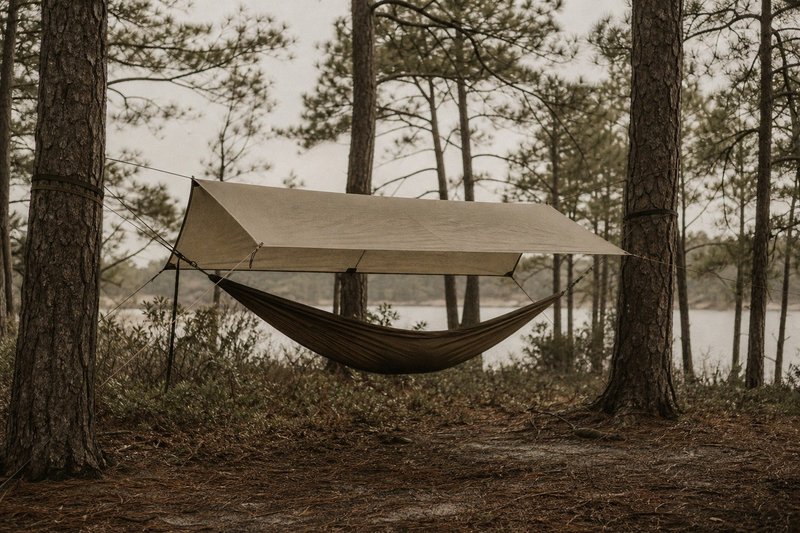
01 — The caseWhy the Croatan suits hanging
Pocosin is flooded evergreen shrub bog. It holds water for weeks after heavy rain, and even in the drier upland stretches the flat ground that makes a good tent pitch is often the ground that collects water. Meanwhile the forest is continuous pine and hardwood — anchors everywhere.
That asymmetry is the whole argument. A hammock camper on the Neusiok has more site options than a tent camper, not fewer, and can stop where the walking gets tiring rather than where the map suggests. Over twenty miles of alternating bog and upland, that flexibility is worth carrying a slightly odd-shaped kit for.
02 — SitesAnchors, sites and the rules
Backcountry camping requires no permit anywhere in Croatan National Forest, which makes a spontaneous overnight genuinely spontaneous. Along the Neusiok corridor the three trail shelters give the route a natural rhythm, and hanging near one is common practice.
Use wide tree-friendly straps rather than rope or webbing that bites. The pines here are working trees in a managed forest, and the etiquette is the same as anywhere: leave the anchor unmarked.
Field noteLook up before committing to a pair of trees. Standing deadwood is common in the pocosin margins, and a widowmaker over a hammock is the one hazard worth being fussy about.
03 — DampInsulation, condensation and coastal damp
The two things that ruin a hang here are both moisture-related. The first is tarp coverage: coastal rain arrives at an angle, and a tarp that just covers the hammock in still air will not in wind. The second is bottom insulation, because a compressed sleeping bag under a hammock stops insulating at exactly the point where you need it to work.
Below roughly 60°F that means an underquilt or a closed-cell pad. The down-versus-synthetic question has a genuinely coastal answer: down is lighter and warmer per gram, synthetic tolerates three damp days better. Detail on shape, tarps, bug nets and insulation sits in the gear guide.
Insects are the other half of the season problem. Between May and September a bug net is not optional on this coast — the seasonal grid shows how sharply the pressure falls away in late autumn.
04 — The sceneThe local hanging community
North Carolina has an unusually active hammock-camping scene, and a good deal of the accumulated knowledge about hanging in coastal-plain conditions came out of group hangs and gear threads rather than from manufacturers. Much of the discussion that grew up around this trail concerned exactly the questions above: what tarp, what insulation, what to do about the deerflies.
Related notes on filters, stoves and camp seating are collected in the gear section, and trail food — including the bear-bagging question that any overnight here raises — sits on the food page.
05 — QuestionsCommon questions about hammock camping here
Is hammock camping allowed in Croatan National Forest?
Yes. Dispersed backcountry camping needs no permit anywhere in the forest, and hanging is treated the same as pitching a tent. Use tree-friendly straps rather than rope.
Why is hanging so popular on this trail specifically?
Because the ground is the problem. Pocosin holds standing water for weeks after rain and flat dry pitches are genuinely scarce, while trees are everywhere. Hanging sidesteps the constraint the terrain sets.
Can you hammock camp from a car here?
Yes — several of the developed campgrounds have trees within the sites, and car camping with a hammock is a common arrangement. It also makes a sensible first outing with unfamiliar gear.
Do I need an underquilt on the Carolina coast?
Below roughly 60°F, yes. Air moves under a hammock and compresses a sleeping bag exactly where your weight sits, so bottom insulation is the difference between a cold night and a comfortable one even in a mild winter.
Down or synthetic in this humidity?
It is a real argument here rather than a theoretical one. Down carries more warmth per gram; synthetic copes better when everything has been damp for three days, which on this coast is a plausible scenario.
Are there trees on the boardwalk sections?
The boardwalks cross the wettest pocosin, and camping on them is neither permitted nor comfortable. Plan a hang for the pine upland or hardwood bottom either side.